Over two decades of directing engineering teams in connected device platforms, I have watched the same pattern unfold across multiple technology waves. Everyone wants to work on cutting edge technology but few talk about the reality of building when the rulebook is still being written.
Leading a team through established protocols is an exercise in execution. However, directing professional engineering teams when specifications are fluid, reference hardware is buggy and vendor documentation is incomplete requires an entirely different approach to leadership.
Managing the Disconnect
There is often a massive gap between the strategic vision of top leadership and the reality on the ground. Leadership rightfully expects a flawless, top-notch feature because they are focused on the final user experience. Engineers, however, look at the underlying standard and see undocumented edge cases, shifting protocols and hardware limitations.
When emerging tech does not work out of the box, organizational friction mounts. Engineers risk burnout chasing moving targets and stakeholders demand to know why timelines are at risk.
As an engineering manager, your primary responsibility is to act as the strategic bridge. You must manage the organizational hierarchy, define feasible deliverables and keep your engineering teams focused and isolated from cross-functional friction.
When Standards Fail: The Miracast Rollout
I have managed this dynamic across several platform shifts over the years. One instance that perfectly illustrates this friction was leading the initial rollout of Miracast on Samsung TVs.
At the time, the wireless display standard was in its infancy. We were establishing the architecture to handle unpredictable source devices, optimize complex H.264 codec negotiations and manage acceptable latency over erratic Wi-Fi Direct connections.
To compound the difficulty, foundational protocols like WFD-RTSP (the specialized RTSP variant for Wi-Fi Display) and wireless HDCP were still being actively shaped. Integrating session negotiation and content protection over a flaky wireless link was notoriously unstable. Different manufacturers were creating their own custom interpretations of the standards by injecting proprietary WFD-RTSP messages or altering HDCP security handshakes. Trying to enforce strict compliance when the underlying network drops packets and source devices speak entirely different technical dialects introduced massive project risk.
When an engineer hits a wall because the official specification dictates one behavior but the raw network packet capture reveals something entirely different, you cannot simply tell them to read the documentation. You must establish a strategic framework for the team to move forward.
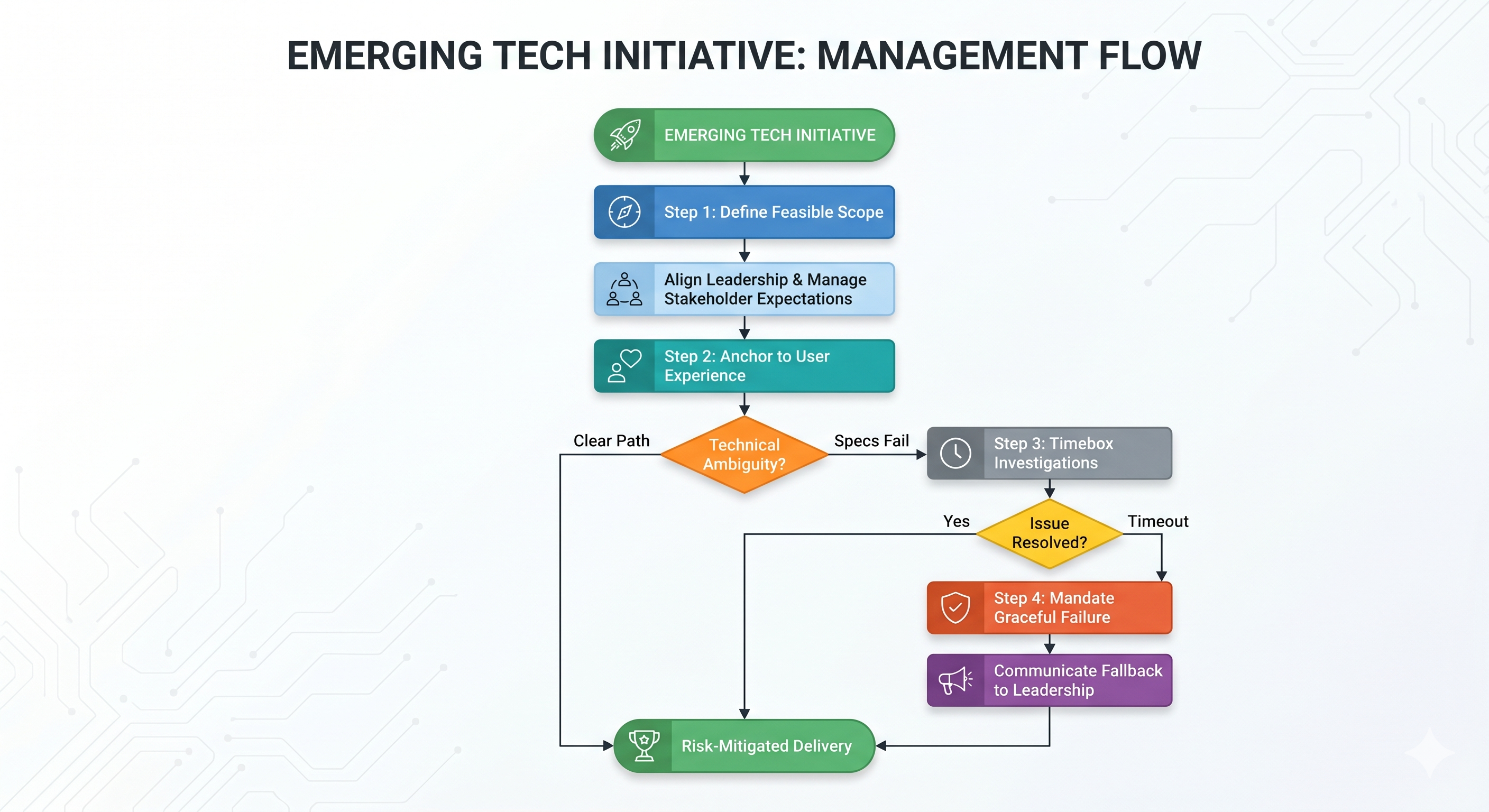
Strategic Directives for Ambiguous Projects
When the path forward is unclear, I rely on four core management principles to control risk and keep the team productive:
- Define Realistic Deliverables: When a standard is half-baked, you cannot deliver a perfect feature. You have to look the leadership chain in the eye and clearly define what is feasible for the current release and what is impossible. Managing stakeholder expectations early prevents catastrophic timeline failures later.
- Anchor to the User Experience: When technical paths diverge and specifications fail, let the end user dictate the strategic priority. During the Miracast integration, we frequently faced hard trade-offs between maintaining pristine video quality and achieving acceptable input latency. Prioritizing responsiveness gave the team a clear directive for making difficult architectural compromises.
- Timebox the Investigations: Emerging tech is full of fascinating but schedule-killing anomalies. As a manager, you must establish clear resource boundaries for how long engineers should investigate deeply ambiguous issues. If a protocol bug cannot be isolated within a set timebox, you must direct the team to pivot to a workaround or escalate the issue directly to the vendor.
- Mandate Graceful Failure: Systems built on fluid standards will encounter unexpected states. You must shift the engineering culture away from seeking perfect architectural purity and towards building robust fallbacks. The goal is ensuring the system degrades gracefully rather than failing entirely.
Ambiguity as a Leadership Test
Directing an engineering organization through the fog of emerging technology is demanding. It requires a delicate balance of deep technical oversight and high-level strategic detachment.
Ultimately, the true value of an engineering manager is not knowing all the answers upfront. It is establishing the framework to find the answers without losing the team, the vision or the timeline.